Don’t work on your weakness

Kaizen is the Japanese word for “good change” or improvement. The word has been adopted worldwide as a philosophy focused on “continuous improvement.” Continuous improvement is what we all want for ourselves. KaizenIf you don’t, you’re a pessimist and I’m going to ignore you because your opinion doesn’t matter. For those of us who want to make a sincere effort to improve (ourselves or some activity), we need to change our behaviour to get better results. Whatever you do, don’t work on your weakness. It’s a waste of time.
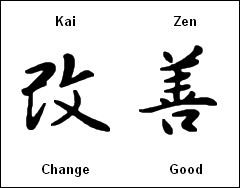
It’s simple, really: focus on your weakness and you focus your entire being on negative pursuits. Focus on your strengths, on the other hand, and you focus yourself on positive pursuits.

There is a human tendency to self-criticize and exaggerate one’s own shortcomings. Sometimes we make up shortcomings that aren’t even relevant just to have something to focus on, attempt to control and beat ourselves up about. Teenagers will look with burning envy at somebody else kissing their crush and instantly compare themselves with their rival to find things wrong with themselves. Being teenagers, they usually pick some irrelevant physical feature and obsess over it.

What’s the consequence of this weakness obsession? Pointless activity that wastes time. You are human (presumably) which means you have a time limit on your life. If you are spending time doing something that doesn’t help you while you’re alive, and will mean nothing to anybody else when you’re gone, it is a worthless activity.

Realize that your “weakness” is a judgment that comes either from your own flawed human psyche, or from others who want you to behave a certain way. Both work on your insecurities. Any effort to satisfy your insecurities is a Sisyphean task. Trying to fix your source of insecurity is like trying to fill an in infinitely deep hole one shovel load of dirt at a time. No matter how much dirt you shovel, the hole is still infinite. Your insecurities are wrong, and anyone who makes you focus on your weakness is projecting his self-loathing onto you. Ignore your insecurities and they will just wither away.

The best reason for not improving your weakness is that it doesn’t exist. We only think it exists because we’re told there is a right and wrong way to do things. Why? Because we’re born into a world of rules made by people who came before us. Most of those people are dead. They tell us that a particular activity is important and it’s done using a certain technique, so you’re judged on how well you copy the technique. If you fall short in your performance, it’s blamed on your weakness and you’re told to improve upon it. Really? So, a bunch of dead people gets to dictate how I am supposed to do everything?

In this photo, Charles B. Tripp is using his toes to hold utensils because he has no arms. He has good reason for following the rules of stepdancing.

In this photo, Charles B. Tripp is using his toes to hold utensils because he has no arms. He has good reason for following the rules of stepdancing.

This is how a lot of silly etiquette rules come about and why Irish stepdancers don’t move their arms. Look, if you want to live your life that way, it’s fine. Go ahead and do that. I want to move my arms.

I don’t believe in weakness. As soon as I don’t believe in weakness, it doesn’t exist. And there is absolutely no negative consequence to this belief system. There is no right or wrong way to do anything. You choose a goal that you want to accomplish and you find your way to achieve it. Use your strengths to reach your goal. Find the way that works for you. The faster the better. Like I said, life, as you know it is ticking down and you don’t know when the final buzzer is going to end this game.

Besides, working with your strengths is a lot more fun. Don’t you want to have fun? If you’re going to embrace the philosophy of kaizen, I think it should include a lot of fun.

Standard

Confession through drawing

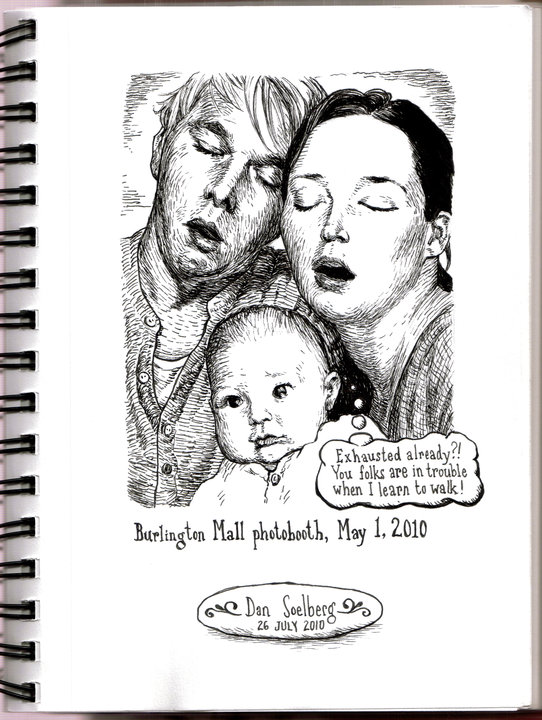
Dan and Jaime in photo boothThe online world can be a public confessional. There is something exhilarating and cathartic about letting everybody know who you are without shame. The master of confessional artwork has got to be Robert Crumb. Crumb rocketed to fame with the 1960s underground comic movement. So, when he draws scenes from his own life, they tend to look like comic book stories: they’re graphic narratives that reveal the artist’s psyche and motivations. What makes his confessional work so striking is the uncompromising depiction of Crumb’s own fragile, conflicted human state. He is relentlessly honest and does not censor or edit his thoughts. While Crumb has drawn a lot of attention to his sexual aberrations and self-admitted misogyny, he also has an amazing ability to depict banal, ordinary life. I like those moments. That is what I want to show and I’m not entirely sure why.

Dan and Jaime sleepingHalloweenBall of GreyIn March 2008 I started a personal sketchbook. I had the idea of telling my life’s story through photo booth photos and uploading them to Facebook as my profile photo. The photo booth is a place where we take staged photos, and I like the conversations that happen before and during the moment of the flash. So I’d make a drawing based on a photo and draw speech bubbles to flush out the back story of the moment. The only problem is that the traditional photo booths that use film were quickly being replaced by horrible, lacklustre digital booths. What tragedy! I tried the digital booths a few times and just hated the look of the photos. I refused to use them as drawing reference. Then I couldn’t find any film photo booths at all and my idea died. My heart sank at this cold, digital photo booth revolution. So goes “progress”.

My personal sketchbook also depicts scenes from my childhood, as well as current moments that I’d like to remember. In 2011 I started filming my drawings from blank paper to finished product. I’d edit the footage, add a song to the soundtrack and speed up the movie to fit the length of the song.

Looking at what I’ve filled the pages of my sketchbook with so far, I definitely don’t have any controversial Crumb-esque drawings. Maybe I’m not digging deep enough. While my intent has always been to show ordinary life moments, I’d like to be more confessional in my work. I’ve never truly voiced myself through my work before. It’s time.

Standard

Hour of the Wolf, with Mike Rooth

"Sabretooth the Barbarian" by Mike Rooth.

“Sabretooth the Barbarian” by Mike Rooth.

I love learning how creative people work. Sometimes learning how others go about their process makes me rethink my own.

Mike Rooth (far left) is completely at home at Toronto's recent Comic Con

Mike Rooth (far left) is completely at home at Toronto’s recent Comic Con

Mike Rooth is a friend and phenomenal illustrator who wrote on Facebook recently: “I’m way better at what I do at 3am than I am at 3pm. The Beast runs wild in my veins at this time, especially after drawing non stop all day and night…”

I’ve felt that. Anybody who’s hit a groove in their creative work has felt a surge of energy that just snowballs. I wanted to know more about what makes Mike’s illustrations better after working hours on end. So I asked him. Mike gave some great insights. He calls it the Hour of the Wolf. I’ll let Mike explain:

“When I’m on my second wind and pushing into the wee hours of the morning on a drawing I can feel those little electrical creative connections link up in my brain meat and send lighting bolts down my arm that blast out onto the page more fluidly and confidently than at 3pm, say. This is a very personal solitary business to work in, and usually at 3am there is no one around to bounce ideas off of or get feedback, so it’s all up to me.”

It’s clear Mike loves creating artwork, and submerging himself in solitude to work for hours on end provides an amazing opportunity to explore and innovate in his process. The freedom he feels to let loose empowers a creative drive within him that he calls ‘the beast’. Mike says it best:

“The Beast likes to run wild. I’m often surprised while working on something very specific – an image or composition that has been crystal clear in my mind from the get-go will often change or go in surprising directions whilst I’m working within the hour of the Beast – and it often does so with confidence, and so I just go where it takes me.”

There is an interesting flip-side to this. While working for dedicated hours without rest can lay the grounds for innovation, you might think that doing something completely unrelated for hours on end would kill innovation and weaken your skills. In fact the opposite is true. A few years ago, Mike took a job as a custodian/superintendent to help pay a few bills. He was not happy about it.

"F.O.R.D.O.K." is Mike's illustration of a well-known mayor.

“F.O.R.D.O.K.” is Mike Rooth’s illustration of a well-known mayor.

“I was worried that spending long periods of time out of the studio doing menial tasks would soften my drawing skills and syphon my creativity and motivation… but a surprising thing happened – my work got BETTER. While I’m outside cleaning up after filthy humans, sweeping up cigarette butts and trash, and scraping bubblegum off the sidewalk- my thoughts are already in the studio, and the Beast is sharpening it’s claws all day waiting for me to get back there… so the time I do get to spend drawing is much more impactful.”

Mike and I will be at the Comic Expo at Humber College this week at two campuses. The event will run Wednesday March 19th at Humber Lakeshore (3199 Lake Shore Blvd W, Toronto), and Thursday March 20th at Humber North (205 Humber College Blvd, Toronto), from 11am-3pm both days. I will have books and merchandise for sale.

Connect with Mike Rooth and see more of his work:

https://www.facebook.com/mike.rooth1

twitter/instagram: @uncouthrooth

Standard

Your name on a bookmark

Signed Bookmark - Dan Holst SoelbergThe first time I faced the public with my published book was at the 2008 Mississauga Book Fair in Mississauga, Ontario. I had 100 books printed and they were not cheap. It was embarrassing, really. My little 6″ x 6″ soft cover cost $32. I didn’t know anything about printing books at the time so I just hired a local printer to do it and wound up paying through the nose. To make this expensive little book a little more enticing, I called it a limited first edition and hand numbered every copy. It worked. I sold out.

But I hated the fact that I had only one expensive product. I knew not everybody had an extra $32 burning a hole through their pockets and I wanted to offer some kind of personalized memento. This is way before I got into merchandising. The only other thing I had at my table was a stack of bookmarks. Lightbulb! If someone seemed genuinely interested in my work, I offered to write their name on a bookmark in my signature writing style. Voila, free memento! It really took off. In fact, people were so excited to see their name come out of my pen that I would often get the same person returning with the bookmark in hand, accompanied by others who were pointing excitedly at me and sheepishly getting up the nerve to ask for their own customized bookmarks. Needless to say, the stack of bookmarks didn’t last long.

I’ve done the same thing at every exhibition, convention and fair since. You could say that writing names on bookmarks has become my signature schtick, but it’s more than that. It connects me to my fans in a profound and personal way. People are genuinely honoured that I have taken the time to make something just for them. And it goes both ways. I believe everybody deserves to feel honoured. It humbles me to know that my work is appreciated and I find this moment we share opens up sincere conversation.

Any time I have the opportunity to customize an order I am happy to help. Here’s a short video showing how I personalized a recent order for Barbra.

I met Barbra at Toronto’s Bazaar of the Bizarre in December 2013. I was exhibiting my books and other products and she just happened to stroll by. Barbra was ecstatic about my work so it was an absolute pleasure to customize this for her.

If you see me at a future convention, don’t be shy to ask for your name on a bookmark. It’s what I do. It’s my way to say thank you for appreciating my work.

Standard

For the love of type

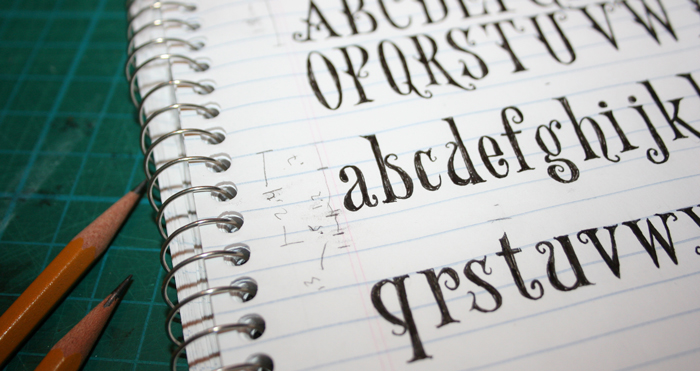
New Dan Holst Soelberg typefaceI just finished the prototype for a custom type style to be used in my new book project. This is a special joy for me. I have filled dozens of notebook pages with preliminary scribbles and scrawls to find a type style that is appropriate for my new book. I think I’ve finally nailed it, although I’m sure it will still evolve.

I am a typography fanatic. One of my most treasured books is called “The Univers by Adrian Frutiger”, written by professor of typography Friedrich Friedl. I picked it up years ago in The Danish Museum of Art & Design located in Copenhagen, Denmark. This book opened my eyes to the intense passion Frutiger has for clear and concise communication. He slaves over every curve and line in his type design to create a unified and harmonious typeface in all its weights. His typeface “Univers” was first published in 1957 (the same year Helvetica debuted) and remains a remarkable typeface still very much in use.

A sample of text from the book Eight Pound Fly. The baseline is purposely completely wonky.

A sample of text from the book Eight Pound Fly. The baseline is intentionally meandering.

Having said all that, I have never endeavoured to create my own typeface to rival the work of Mr. Frutiger. My text design is never truly original. I love mixing and matching ideas from dozens of existing fonts. My own “fonts” remain hand-drawn with all their variations and rough flaws left unpolished. It’s just a creative impulse that I’d rather not control too much.

Dwellers of Lurching Swill text sample

Sample of text from the book Dwellers of Lurching Swill.

As with previous projects, I’ve written out the roman alphabet in upper and lower case, but I tend to tackle the rest of the punctuation and glyphs as they pop up. I like spontaneity. It’s for this reason that I hand-render every letter in my books individually. So far, that’s the plan with this book as well.

So, while I love and respect the rules that govern formal typography, I also have a soft spot for erratic inconsistencies that show the hand of the human who created them. I’m sure Adrian Frutiger would not approve.

Standard

Why pessimism is pointless

Cutting illustration boardsI’m cutting illustration boards into 29.8 cm squares (the perfect dimension) for my latest book project and I’m bursting with excitement to get going on the illustrations!

I don’t know about you, but for me there is something irresistible about finding out what someone is passionate about and the projects they work on in private. It’s both fascinating and inspiring. The excitement is contagious. It makes me want to jump headfirst into my own passion-driven projects with renewed vim.

I used to talk openly about anything I was working on with anybody who asked. That’s changed. Now I hold back. What happened to change my mind? I encountered difficult attitudes.

Cynicism, doubt, judgment, arrogance. Take your pick. I can sum them all up with one word: pessimism. I’m sure you’ve met the type. Some malcontented misanthropes take special glee in dumping buckets of cold water on any fresh idea that threatens to spark up. Someone I know has proudly labeled herself a pessimist, claiming that pessimism is better for your health than optimism. She quoted a study that came to this very conclusion. It’s one of those cute and soft pseudo-science factoids of the day that makes for a catchy radio sound bite on the morning commute. Rubbish! I can point to a slew of valid scientific studies that come to the opposite conclusion, so that argument doesn’t hold any water.

The prevailing argument for pessimism is that it is a “dose of reality”. It isn’t. Pessimists molest you with their self-righteous, cranky, glass-half-rotten opinions served on a soured scowl and a kick in your teeth for “your own good”. Don’t get me wrong, I think a healthy dose of skepticism is a necessary part of anything I do. But there is a wide ocean that separates the shores of skepticism from pessimism. They are not the same. Skepticism employs logic and critical thinking. Pessimism is an unresolved childhood.

Am I so thin-skinned that I can’t take criticism from others? Far from it. But pessimists discourage, which is not at all useful. Instead, I often take advice that helps steer my projects in the right direction. For instance, when I self-published my first book I met with publishers, bookshop owners and many other writers and illustrators who have self-published to learn how I can make my own books successful. As a result, I have changed my approach to self-publishing, and three books later I’m still learning and adjusting.

Well, that’s it for today! I’ll make a point of showing you teasers from my new project as it develops. I’d love to get your opinions and advice to make my next book a viral success. In fact, I’m in the midst of promoting my latest book Dwellers of Lurching Swill. Do you know a publisher, do you have a favourite bookshop? Do you know a book reviewer, television show, podcast or a website that could promote my work? Maybe another blog that would feature my book? Please send me your suggestions. Until next time, stay warm!

Standard
rejection letters from all the big syndicates

Failure is positive

Is failure a topic we want to learn about? I think it is. Failure gets a bad rap. I don’t think failure is given the positive attention it deserves. Hopefully by the end of this article, you will feel compelled to shine a light on your own failure to motivate confident action.

First, let me continue my story from last entry. In grade eight I learned a great deal from Ben Wicks about cartooning but I didn’t take action right away. Jump forward to 2003 and I was exhibiting my artwork in galleries across southern Ontario. Soon after, I was also attending a graphic arts degree program.

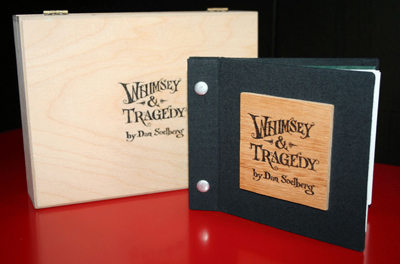
Whimsey & Tragedy hand-made book

My hand-made, one-of-a-kind book and its wooden case. This was the precursor to my first published book.

For one of my classes I created a hand-made illustrated book of macabre poems that I called “Whimsey & Tragedy”. You can see a video of a poem from this book here. By late 2007, my artwork was evolving and I was developing ideas for spot illustrations that had accompanying rhyming couplets. I really liked where this was going but I wasn’t sure if this fit into my gallery exhibitions. In 2008, I had the idea to make these illustrations into a series of cartoons that I would sell to a cartoon syndicate. In case you don’t know, syndicates distribute cartoons to publications worldwide and represent all the successful cartoonists who earn a living from their cartoons. I’ve been an active writer (writing a column for my local newspaper for a couple of years) and graphic designer since early high school so it seemed like I had all the skills and tools to pull this off. It felt right.

This is when Ben Wicks’ voice started up in my head. His advice flooded my thoughts, and I realized that this was the time to give it a go. There was one thing I screwed up in a huge way though. Huge. For financial reasons, Ben told me explicitly to marry a nurse. I did not. I didn’t just not marry a nurse, I married another creative person. I had been married to Jaime for four years. I told Jaime about Ben’s advice and we both realized what a dumb, dumb thing we’d done. On the plus side, we were madly in love, we both had decent jobs in graphic design and we owned a house, so we weren’t complete idiots. All the cartoons I was making meant that I had little time to create artwork for gallery exhibitions, so they dwindled down to just one or two a year.

"Gwyn" was the first finished cartoon. It set the tone for the rest of the series.

“Gwyn” was the first finished cartoon. It set the tone for the rest of the series.

Once I had my first twelve panels complete I started sending off to the syndicates. At this point I was firing shots in the dark. I had no idea how to get my cartoon from “not being published” to “being published“.

Then I received my first rejection letter. I love rejection. It’s my favourite flavour of failure. I needed information to help guide me and that’s exactly what rejection does. There are two very valuable pieces of information I learn when I am rejected, especially when I’m given reasons for the rejection (which I was):

#1: Rejection helps me find an audience for my creations.

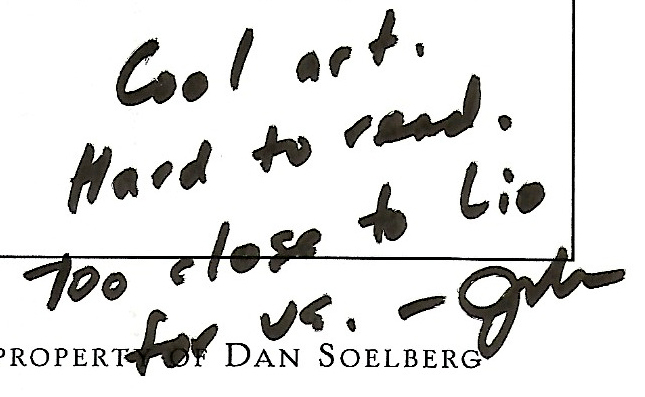
John Glynn's hand-written note is honest and direct. This was probably the most valuable bit of direction I could hope for.

John Glynn’s hand-written note is honest and direct. This was the most valuable direction I received from any of the syndicates.

For instance, editor John Glynn at Universal Press Syndicate wrote me a marker-scrawled note, which said that my hand rendered lettering is “Hard to read”. In other words, John’s saying that his audience will find it hard to read. There are two intelligent ways to respond: I could change the text to a standard typeface and resubmit, or I could find a medium other than cartoon syndication that accepts my hand lettering. The point is, I get to decide what I will and will not change to uphold the integrity of my work, which in turn determines how my work is published and determines the audience I have access to. If I want the cartoon syndication audience, I’d better change my lettering. You can apply the same lesson to any new idea or product you propose in the business world: In the face of rejection you can decide to make the changes suggested, or you can find another application for the idea.

#2: Rejection gives me insight to what is currently successful and what isn’t.

If I have a cartoon that is completely different from anything that’s ever been done, chances are that nobody will hire me. It’s too risky. They want something that fits in with whatever is currently successful, but has one element that distinguishes it. However, if it’s too similar to something that’s already being published, nobody will hire me either. For example, that same rejection note from John Glynn also said “Too close to Lio”. Since I had never heard of Lio, I researched. I discovered that Lio is a macabre cartoon. I was going for macabre, so I hit my target. Unfortunately, John felt there was not enough to distinguish me from Lio. Again, you can apply this valuable lesson to any new idea or product. If someone thinks your product looks just like something that’s already on the market, you may have to do some serious retooling.

Over the course of a few months I was rejected by the best: Universal Press Syndicate, Tribune Media Services, Washington Post Writers Group and Torstar Syndication Services. Actually, I submitted to Torstar twice and was rejected the same number of times. Some were just form letters but others had personalized advice and encouragement. By this point I was already planning to assemble a cohesive book and I didn’t feel much like changing anything. I liked it. But it really didn’t matter what I thought because the syndicates were unanimous in their rejection of me. So I chalked up all this rejection to a fantastic failure. I decided to give up on cartooning, at least for the time being, and move on.

Sometimes giving up on a goal is the best way to focus on a new one and keep the momentum going. I was excited to make a book. I was even more excited to get feedback from the public. What would they think? I was ready to find out.

Standard
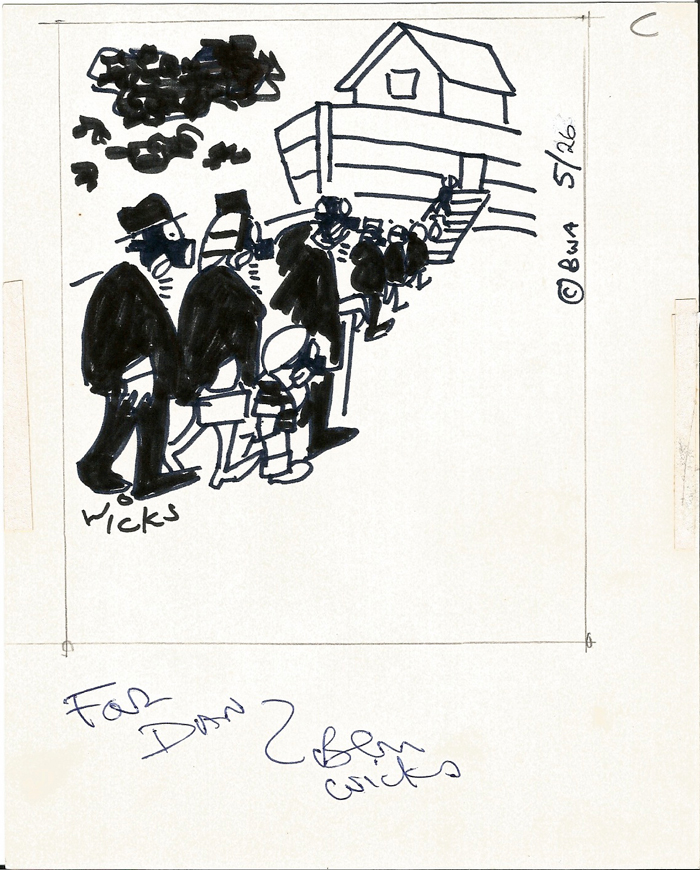
An original Ben Wicks cartoon

My original Ben Wicks artwork

After my last blog post, I was determined to find the original artwork that Ben Wicks gave me back in grade eight. I looked in every possible nook and book I could think of. Nothing. I convinced myself that it must be tucked between some yellowed volumes in my old bedroom in my parents’ house. As luck would have it, my parents still live in the same house. As luck would have it again, I was at my parents’ house a couple days ago and had the opportunity to empty my old bookshelves. Oh joy! I am happy to have the artwork in my possession once again! I’ve decided to frame it and give it a new place of distinction in my studio.

The Second Ben Wicks Treasury, Methuen Publications

The Second Ben Wicks Treasury, Methuen Publications

A side note: several years after I met Ben Wicks, I bought “The Second Ben Wicks Treasury” in some random bookshop I happened to stroll by. It’s a wonderful collection. There was a little surprise in it that I didn’t notice right away because I don’t always read books in proper order from start to finish. It must have been a full week after buying the book that I flipped to page 24 and was faced with the cartoon that Ben Wicks had signed and given to me.

Thanks again Mr. Wicks.

Standard

5 tips to be a successful cartoonist – with Ben Wicks

Last time, I mentioned that I set out to publish a syndicated cartoon six years ago. I was telling the story of going to famous cartoonist Ben Wicks’ office when I was in grade eight to get his secret formula for cartooning success. Armed with a tape recorder and my interview partner Kris, we grilled Ben Wicks. Well, I’ve gotta be honest – now that I’ve just listened to the tape of my interview, my grilling amounted to little more than a spark and a wisp of smoke…and I’m exaggerating about the smoke.

Photo of Ben Wicks, Kris Platts and Dan Soelberg

This photo was taken in Ben Wicks’ office after our interview. Pictured here are Kris Platts, Ben Wicks (as if he needs the desk sign!) and myself.

At any rate, Mr.Wicks was generous with his time and gave some great advice. I feel very fortunate to share my interview with Ben Wicks, who unfortunately died of cancer in 2000 at age 73. Without further ado, Here they are: Ben Wicks’ 5 key points to making a success of your cartooning ambitions:

#1: Bide your time

“I left school at 14. I worked in the market selling fruit. I’ve had 30 jobs since I left school. I have no degrees or anything else, so I’m an absolute idiot as far as education is concerned. The one advantage I had in education was that the education of life gave me the opportunity to meet people in various jobs. So from working with Irish labourers on the building sites, to being a milkman to working in the market to being a glider pilot, whatever, gave me the opportunity to experience various things. (…) Then I was a professional musician for nine years, came to Canada with my wife, ended up in Calgary, did a number of jobs and then one day decided that I’d send some cartoons off to the Saturday Evening Post, which was the top magazine at that time and was very lucky. They bought them and I began drawing for them. That’s how I got started.” I asked “How old were you then?” Wicks answered, “God, I was very old. I was 31, 32. So you’ve got lots of time.”

#2: Think of a cartoon as a four-act play 

“When you’re doing cartoons, try and think of a cartoon strip. A cartoon strip is really a small play. It’s a four-act play, that’s what it is. The first little picture that you draw is the first act, then the second act, then the third act, and then the final act when the curtain comes down. So, consequently it’s very important that you concentrate on the strip cartoon because what you’re actually doing is you’re writing very short four-act plays. The reason I say this is because the world of theatre and the world of film and the world of story telling is much more in need of people than the newspapers are in need of cartoonists. (…) The great value for you and why it’s essential that you think in the cartoon strip is that as you draw it you’ll be writing dialogue so it improves your English and it’s extremely important that you have a sense of what the language is about that you’re drawing in. So, with the cartoon strip, you’re not only writing dialogue, you’re writing a play. But you’re fitting the characters to the dialogue. Obviously, you’re not going to have the Queen of England say bugger off. She’s going to speak very swanky and posh. So you write that dialogue to fit her.”

#3: Write

“Many cartoonists turn to writing. And I would really, strongly advise you to not only continue enjoying the cartooning aspect, because then you have a terrific start on those that want to become play writes. I know you didn’t expect to hear this. You probably thought I was gonna explain this magic way you were gonna become a cartoonist. (…) Don’t set your sights on cartooning as a way to earn a living. It’s too much an empty world. (…) It’s fun to do. I’m not telling you to stop doing it. I want you to carry on doing it. But I want you to set your sights now on something beyond cartooning. (…) The one thing I found is I have lots of time to spare. I’d done the cartoon, y’know what else can I do? I mean, as a syndicated cartoonist, it appears in a couple hundred newspapers, but I don’t have to draw it 200 times. I only draw it the once and send it up to the syndicate and they do all the work. (…) But now I’m finding it much more satisfying to write my books. I mean, this is number 16, this book [motioning to his computer] and that’s 80,000 words.”

#4. Inspiration happens on schedule

“My work in cartooning is an hour on Monday mornings for the week. That’s all it takes. (…) I come in on Monday morning and I sit and stare at a few pieces of paper and I don’t do anything till then. You find as a political cartoonist there is so much happening in the world that it’s not difficult.” I asked, “Do you maybe lie in bed and think, hey I’ve got an idea?” “No, I do not!”, Wicks replied, “No, I don’t think of anything until I come into work. (…) If I’m really stuck for an idea, because you do work for deadlines, I do usually two politicians facing each other and I open both of their mouths, and I find you only have to stare at that picture for about one minute and then one or the other will say something stupid and you just write it underneath.”

#5. Marry a nurse

I asked Mr. Wicks “Did you have enough money to live on when you started?” Wicks answered “No. I was fortunate. This is the other thing that is very good information to give you. If you can, before you start thinking about earning a good living in cartooning, try and find a wife who’s a nurse who also has a good living.”

After the interview, Mr. Wicks led Kris and I to an enormous set of paper drawers where he slid one giant drawer open to reveal hundreds of original cartoons drawn on postcard-sized cards just scattered in heaps. This is how he kept his published work! It was an amazing treasure trove. He let us each choose one and signed them for us. I still have the cartoon…somewhere. When I got home, I drew a caricature of Ben Wicks and mailed it to him with a letter of thanks. He sent me back a hand written letter of encouragement. I cannot express what a wonderful influence Mr. Wicks has been on me. A true gentleman with a bursting heart of gold. He is dearly missed by all who had the privilege to meet him.

Hope you enjoyed this. Next time I’ll let you know how Ben Wicks’ advice has been invaluable to me and why I’m not currently cartooning for a syndicate. I’ll take you to the moment six years ago that led me to the path that I now find myself on. Until then, take care.

Standard

What am I doing?

I’m not entirely sure, to be honest. I know I’m having a wonderful time making books and I have many more to make. But this might very well change. I know because it already has changed. In fact six years ago I had set out to do something very different. Six years ago I decided to make a syndicated cartoon.

The idea of making a cartoon didn’t come out of the blue. In eighth grade, my teacher Mrs. Volkwijn asked the class to do a research project on “what I want to be when I grow up”. That’s when I decided to look at “Cartoonist” as a legitimate profession. I wanted to interview one of the most prominent Toronto cartoonists, Ben Wicks.

Ben Wicks, a much-loved cartoonist who was also a TV host, broadcaster and humanitarian, is shown working in his home. (Courtesy of the Wicks family)

Ben Wicks, a much-loved cartoonist who was also a TV host, broadcaster and humanitarian, is shown working in his home. (Courtesy of the Wicks family, sourced from cbc.ca)

He had a little square cartoon on the bottom corner of Toronto Star’s front page every weekday and Saturday. I figured, if anybody knows what it  takes to be a cartoonist, Ben Wicks is my man. Besides he was on tv so he must have been doing something right. He was involved in a nationwide public service ad campaign on television during the winter that asked viewers to clear snow and ice from sidewalks. The campaign carried the catchy slogan “be nice, clear your ice”. Ben Wicks lent his signature drawings to the ads and his recognizable voiceover. So, I looked up Ben Wicks in the white pages and called him. Mr. Wicks answered in his famous Cockney accent and graciously agreed to a fifteen minute interview and asked me to bring a tape recorder so he didn’t have to stop talking while I wrote down his answers. My mom chaperoned an outing with my research partner, Kris. Kris was an avid artist like myself but I’m pretty sure I talked him into sharing my future ambitions. wicks_judge-714052We drove to the Yorkdale Mall and took the subway to College station. Wicks had an office above The Red Lion at 449 Jarvis Street. I pressed the buzzer and he let us in. The space was a warm and lived-in office with a computer in the corner by the window and a lounge area with a couch and chairs around a coffee table. After introductions we sat down and I pulled out my enormous tape recorder and plunked it on the coffee table between us. Kris and I took turns asking our prepared questions.

I’m back. You didn’t know that I was gone but I was. Anyway, I just took a break from writing to scour my house for a couple things. One of them is a photo my mom took of Ben Wicks, Kris and myself. Found it! I also ransacked my studio to find the dusty old cassette with the actual interview and a Sony walkman to play it. Found those too. It has been a very, very long time since I heard this and I’m actually pretty stoked! I’ll listen to the interview tomorrow. I’ll post the photo and my reaction to the interview in the next post. Stay tuned!

Standard